SurakshaNet - Disease Surveillance & Outbreak Alert System (Nepal)
SurakshaNet is a Django-based disease surveillance and outbreak-alert platform built for Nepal. It helps health authorities manage disease cases across provinces, districts, municipalities, and health facilities while understanding disease patterns through interactive maps, dashboards, and analytics. The system includes case reporting, demographic analysis, GIS mapping, outbreak alerts, case investigation, laboratory-sample tracking, reporting exports, and role-based access control. It also provides a public portal where citizens can explore disease information, maps, epidemiological bulletins, and health advisories. By bringing these services together, SurakshaNet supports faster reporting, clearer disease visibility, and more informed public-health decision-making.
Problem
Paper-based and manually aggregated case reports can delay outbreak detection, make disease trends difficult to see geographically, and require staff to notice rising case counts without automatic support. SurakshaNet responds by creating a shared digital record for case reports and applying threshold-based alerting at the disease and district level.
Objective
To design and implement a web-based disease surveillance and outbreak-alert platform for Nepal that digitizes case reporting, automates outbreak detection, and presents disease burden geographically and statistically.
Solution
Developed as a Health Informatics Project I (HIMS256) at Kathmandu University, SurakshaNet addresses delays and limited spatial visibility in paper-based disease reporting. The system combines internal health-authority workflows with a public citizen portal. It supports individual and aggregate case reporting, district-aware access control, outbreak alert generation, case investigation, laboratory-sample tracking, epidemiological bulletins, health advisories, reporting exports, and notification subscriptions. Its design follows Nepal's administrative structure and was validated through automated testing and manual GIS boundary checks.
My Role in This Project
Academic Project
Healthcare Context
Disease surveillance, outbreak detection, epidemiology, public health informatics, GIS, case investigation, laboratory workflow, health reporting, risk monitoring
Architecture
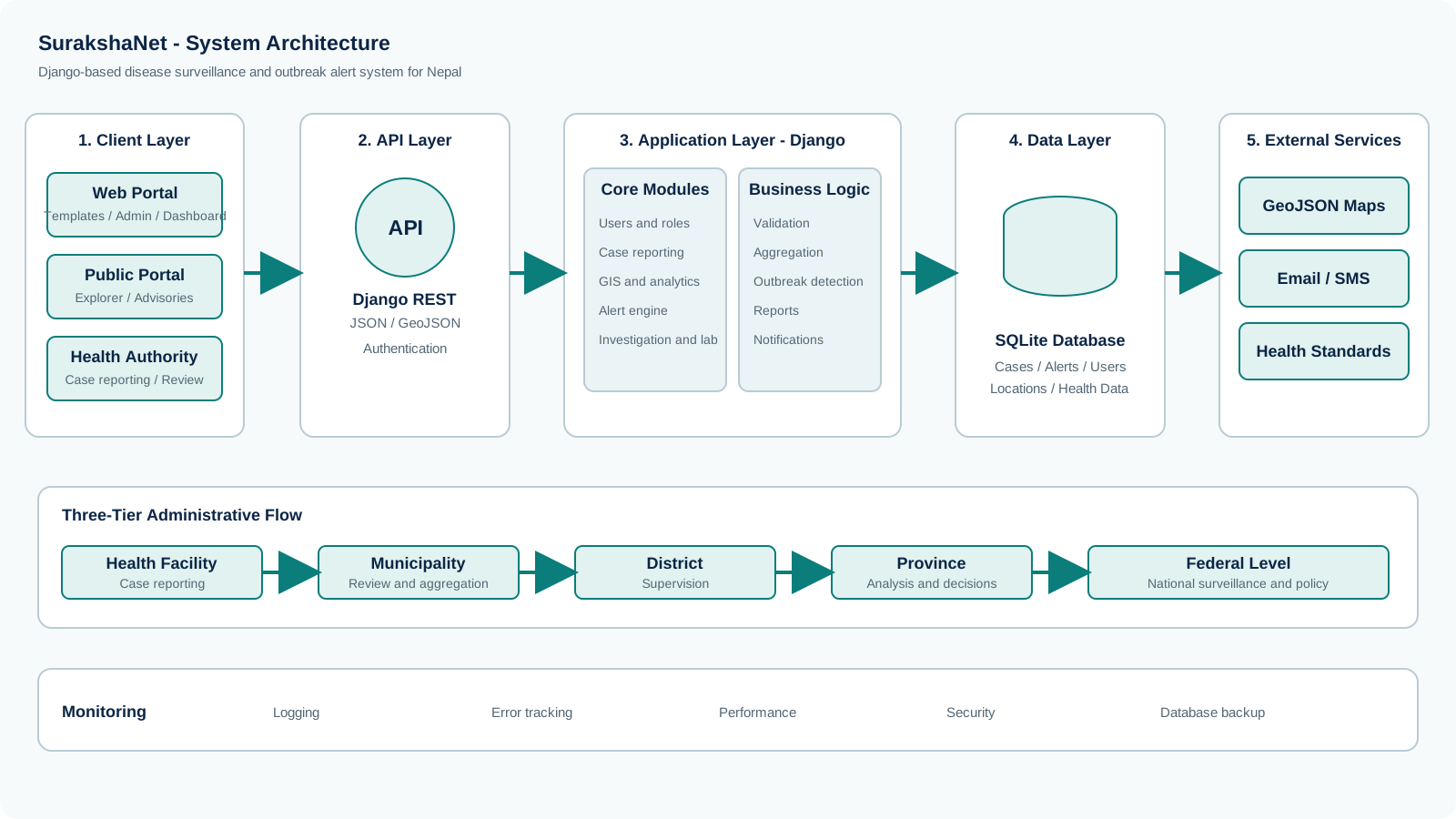
Key Features
- Province, district, and municipality hierarchy
- Individual and aggregate case reporting
- District-locked role-based access control
- Threshold-based outbreak alerts
- Interactive Leaflet.js GIS map
- Chart.js demographic and temporal dashboards
- Public disease explorer and health advisories
- Epidemiological bulletins in HTML and PDF
- Case investigation and laboratory-sample tracking
- CSV, PDF, and HTML reporting exports
- Email, SMS, and WhatsApp notification framework
Challenges
Delayed paper-based reporting, fragmented spreadsheets, limited spatial visibility, and the need to protect district-level data while supporting national oversight were the main challenges.
Solving the Challenges
The project models Nepal's administrative hierarchy, applies district-aware permissions, aggregates case data in the database, generates alerts when configured thresholds are crossed, and exposes GeoJSON and analytics endpoints for maps and dashboards.
Results
The report documents a functioning Django application with 212 passing automated tests at the time of submission, interactive GIS visualization, public-health reporting workflows, and verified municipality-to-boundary linkage. The project demonstrates how a role-based surveillance system can support district health workflows on relatively inexpensive infrastructure.
Lessons Learned
Public-health software must reflect real administrative workflows, protect data at the correct level, and present timely information in forms that health authorities and citizens can understand. The report also identifies the need for PostgreSQL, background task processing, complete production boundary data, and stronger rate limiting before national-scale deployment.